
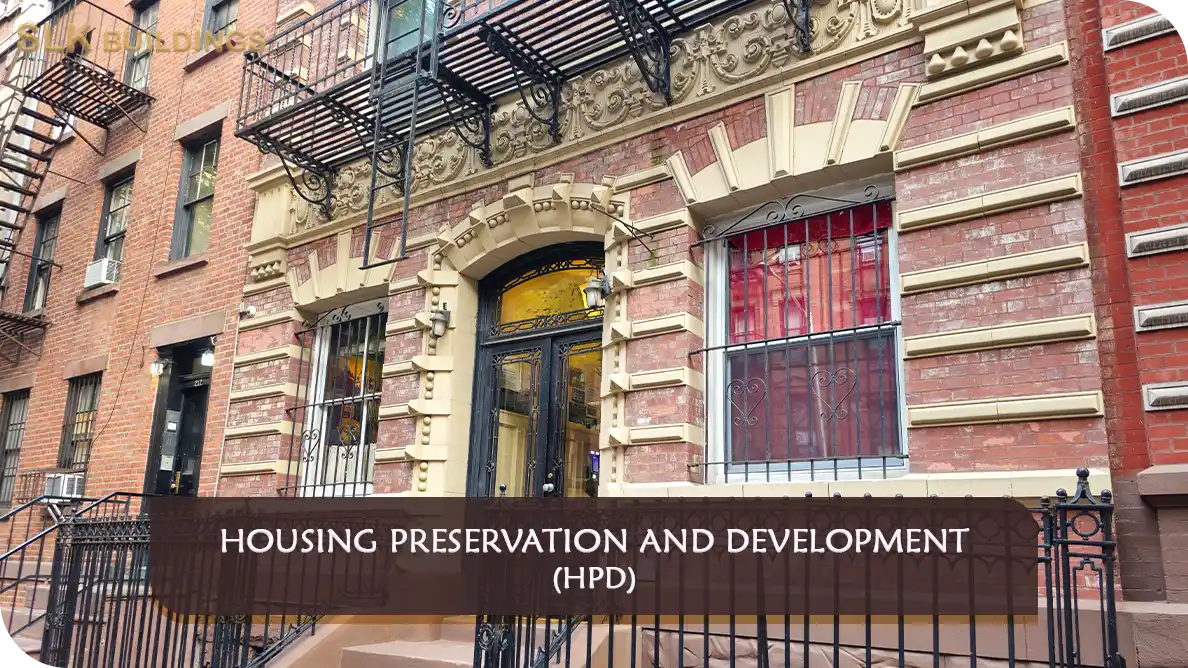
Housing preservation and development in New York City includes programs to maintain safe housing, enforce residential maintenance standards, preserve affordable homes, and help property owners understand their obligations. The New York City Department of Housing Preservation and Development (HPD) is the City agency responsible for many of these activities. For an owner or building manager, the first step is identifying which HPD requirements apply to the property and which information is available in official building records.
HPD responsibilities are wider than violation enforcement, but this SLK Buildings guide concentrates on practical owner questions: Who needs to register a residential building? What happens after a tenant submits a 311 complaint? How do Class A, B, and C violations differ? What makes a correction or annual filing complete? And when must a project team also work with the Department of Buildings (DOB) or another agency?
Explore the NYC HPD Housing Code and Property Compliance Resource Center for detailed guides to registration, inspections, correction procedures, safety obligations, emergency repair charges, and specialized enforcement programs.
Already know which HPD topic you need? Select a service below to go directly to its guide. If you are unsure where to begin, explore the NYC HPD Resource Center.
HPD enforces the New York City Housing Maintenance Code and provisions of the New York State Multiple Dwelling Law. Its Code Enforcement staff typically investigate complaints about conditions inside apartments and residential common areas. HPD also operates housing preservation, affordable housing, financial assistance, and other programs that are not identical to code enforcement. An HPD compliance issue does not necessarily mean that the building is in an HPD development or subsidy program.
For property owners, common interactions with HPD include annual building registration, responding to notices or inspection findings, preserving repair records, and following special procedures for hazards such as lead-based paint or mold. An owner may also need to confirm property registration or existing violations before a transaction, major repair, or housing-court matter. Start with the Housing Maintenance Code guide when you need to understand the underlying residential maintenance obligations.
The requirements vary by building type, occupancy, the condition involved, and the applicable law. HPD is especially relevant to residential multiple dwellings, but some requirements also apply to one- and two-family properties. Do not assume that a small building is automatically exempt from every HPD requirement.
Many owners must submit a property registration statement each year by September 1. HPD requires both the correctly signed registration form and payment of the currently published $13 annual registration fee through the Department of Finance (DOF). The Property Registration Online System (PROS) prepares the form, but owners still need to print, sign, and mail the required document to HPD. Fee payment alone does not make the registration valid.
A change in ownership, address, management, or other registered information can require an updated filing. Because HPD uses registration contacts for official notices, an outdated agent or mailing address can create practical problems even before an inspection takes place. Read HPD Property Registration for property eligibility, instructions, record updates, and potential consequences of nonregistration.
HPD Online is the public record-search system for many building complaints, violations, orders, registration entries, charges, and litigation entries. A search shows recorded agency information rather than a guarantee of current physical compliance. Consult HPD Online Records to understand what can and cannot be confirmed from a property search.
A common path begins with a housing maintenance complaint, often submitted through 311. HPD may contact the tenant or owner and dispatch a Code Enforcement inspector. An inspection may cover the reported condition and additional mandatory safety items. HPD may then issue a Notice of Violation (NOV), which identifies the condition, hazard class, correction instructions, and time-sensitive deadlines.
Violation classes indicate the seriousness of the condition. Class A is non-hazardous, Class B is hazardous, and Class C is immediately hazardous. The published general correction periods are 90 days for Class A and 30 days for Class B. Class C periods vary: heat and hot water require immediate attention; some lead, window-guard, mold, and rodent conditions have a 21-day period; self-closing doors may have 14 days; and many other Class C conditions require correction within 24 hours. The NOV controls the applicable dates.
The HPD Violations and Inspections guide explains what an inspection records and what a notice requires. If a violation has already been served, identify the violation number, class, exact condition, and correction and certification dates before choosing a filing path.
Physically repairing a problem and clearing an HPD record are related but separate tasks. Owners must properly correct the cited condition and, when permitted, submit a Certification of Correction by the deadline shown on the NOV. HPD can audit certifications. A false or unsupported certification may leave the violation open and expose the owner to additional penalties or enforcement.
Some violations can be certified on paper or through HPD eCertification. Lead-based paint, mold, and pest violations follow special documentation processes and cannot be submitted through ordinary eCertification. Owners with older, uncertified violations may need a dismissal request, inspection, or an eligible reissuance procedure instead of a standard on-time certification. Review Violation Certification and Dismissal Requests and Reissuance before submitting documents.

Owners must provide hot water year-round at a minimum temperature of 120°F. During the October 1 to May 31 heat season, the rules generally require indoor temperatures of at least 68°F between 6 a.m. and 10 p.m. when the outside temperature is below 55°F, and at least 62°F overnight regardless of the outdoor temperature. The Heat and Hot Water guide explains these requirements, inspections, and possible emergency repairs. See also the existing lack of heat or hot water violations article.
Lead-based paint requirements can involve annual inquiries and inspections, lead-safe repair methods, turnover obligations, independent X-ray fluorescence (XRF) testing, and years of retained documentation. A major XRF-testing deadline passed on August 9, 2025, but the relevant duties and any enforcement consequences depend on building age, tenancy, and applicable exemptions. Start with Lead Paint Compliance and Lead Paint Testing and Exemptions.
Local Law 55 requires qualifying owners to address indoor allergen hazards and the underlying defects that allow mold or pests to return. Painting over mold without correcting a leak, or repeatedly spraying without closing pest entry points, may not solve the legal or physical problem. Proper methods and qualified providers matter. Read Mold and Moisture Control and Pest Control and Prevention.
Bed bug infestation procedures differ from the annual HPD bed bug reporting obligation for multiple dwellings. Other resident-safety duties include window guards where required, self-closing doors, smoke and carbon monoxide alarms, and applicable notices. See Bed Bug Annual Report, Window Guards and Child Safety, and HPD Fire Safety Requirements.
Owners may have to distribute notices at lease signing, with renewals, annually, or after particular events. Others must be posted in building common areas. Requirements may cover lead paint, window guards, indoor allergens, stove knob covers, gas leak instructions, bed bug filing receipts, building information, service interruptions, and emergency preparedness. The exact notice depends on the building and situation.
HPD adopted an option for qualifying digital postings effective February 2, 2026, but the option does not replace all required printed or tenant-delivered notices. For the applicable categories and conditions, review Required Notices and Signage and the official HPD signage guidance.
If an owner does not timely correct serious conditions, HPD may order work or arrange emergency repairs through its Emergency Repair Program (ERP). The City may then charge the property through DOF, with unpaid qualifying amounts becoming liens. These charges are not the same thing as the original violation or as the cost the owner might have incurred by arranging an authorized contractor independently.
HPD also has targeted programs for distressed buildings, underlying causes of recurrent defects, and properties repeatedly cited for heat violations. These are not automatic obligations for every residential property. Learn which buildings may be affected in Emergency Repair Program, Alternative Enforcement Program, Underlying Conditions Program, and Heat Sensors Program.
Orders to Correct or Vacate, some permit-sensitive certifications, and inspection obligations can require separate procedural attention. The relevant notice and agency instructions take priority. Consult Orders to Correct and Vacate and Certification of No Harassment when these issues appear in the property record.
HPD does not issue every permit or adjudicate every housing-related issue. A defective apartment door, leaking roof, unpermitted conversion, lead hazard, or building-wide mechanical failure can involve more than one agency, with different records and different closeout requirements. Identifying the authority responsible for each item helps prevent filing the wrong application.

SLK Buildings can help review the property’s publicly available HPD history, organize registration or violation documentation, and coordinate next steps with the responsible professionals and agencies. To begin, provide the property address and borough, the HPD violation or order number if one exists, and a short description of the current issue. Contact SLK Buildings to discuss available assistance.
Disclaimer: SLK Buildings is a private business and is not affiliated with the New York City Department of Housing Preservation and Development (HPD), the New York City Department of Buildings (DOB), or any other government agency. Information on this website is provided for general educational purposes and does not replace legal, architectural, engineering, environmental, or other licensed professional advice. Requirements, eligibility, deadlines, fees, violation statuses, approvals, and agency determinations depend on the applicable law, agency procedures, and the circumstances of each property. Where licensed or otherwise qualified professionals are required, their services must be obtained separately as appropriate. SLK Buildings may assist with research, documentation, and coordination within its agreed scope but does not issue government approvals or guarantee violation dismissal, fee reductions, processing times, or outcomes.
New York City Department of Housing Preservation and Development (HPD) requirements affect many residential properties. Owners and managers may need to confirm annual registration, investigate an HPD complaint, correct a cited housing condition, or submit documentation before a violation can be closed.
HPD requirements may overlap with DOB construction permits, DOHMH public health matters, FDNY fire safety, and DOF emergency-repair charges. The correct path depends on the building, the notice or order received, the proposed repair, and whether work by qualified or licensed professionals is required.
SLK Buildings assists with HPD records research, property registration coordination, violation review, correction and certification documentation, agency follow-up, and related DOB or other agency coordination within its agreed scope of services.
Whether a property is preparing an annual filing, responding to an HPD inspection, correcting a hazardous condition, or confirming that a submission was accepted, consistent records and clear next actions help owners and project teams coordinate their obligations.
SLK Buildings provides free educational content to help property owners, managing agents, landlords, contractors, and project teams understand HPD registration, housing-code inspections, violation classes, correction and certification, required notices, emergency repairs, and related DOB and other agency requirements.
For those who prefer professional assistance, SLK Buildings is available to coordinate HPD record review, registration information, correction documentation, repair and agency-response tracking, and necessary coordination with qualified contractors or design professionals. Final decisions and regulated work remain with the responsible agencies and appropriately qualified providers.
Disclaimer: SLK Buildings is a private business and is not affiliated with the New York City Department of Housing Preservation and Development (HPD), the New York City Department of Buildings (DOB), or any other government agency. Information on this website is provided for general educational purposes and does not replace legal, architectural, engineering, environmental, or other licensed professional advice. Requirements, eligibility, deadlines, fees, violation statuses, approvals, and agency determinations depend on the applicable law, agency procedures, and the circumstances of each property. Where licensed or otherwise qualified professionals are required, their services must be obtained separately as appropriate. SLK Buildings may assist with research, documentation, and coordination within its agreed scope but does not issue government approvals or guarantee violation dismissal, fee reductions, processing times, or outcomes.
HPD supports housing preservation and affordability and enforces residential Housing Maintenance Code requirements. Its Code Enforcement division investigates many quality and safety complaints and issues relevant housing violations.
No. Annual registration generally applies to buildings with three or more residential units and to certain one- or two-family homes without owner or immediate-family occupancy. Additional special circumstances may apply; consult the registration guide.
Not necessarily. Many HPD Housing Maintenance Code matters proceed through HPD administrative correction procedures or Housing Court. Verify the issuing agency and the notice type before treating a case as an OATH hearing matter.
No. Physical correction and record closure are different. Owners often need timely, properly submitted certification or another eligible removal procedure, followed by confirmation of agency status.
Not always. Class C deadlines differ by condition; heat and hot water must be addressed immediately, and some other Class C conditions carry 14-day or 24-hour periods. The NOV provides the controlling instructions.
No. HPD directs these violation categories to special certification documentation and procedures. Use the notices and the appropriate HPD forms.
Yes, in qualifying circumstances HPD may order or arrange emergency repairs and bill charges through DOF. The owner should separately examine violation correction and any repair-charge billing or objections.
No. Some repairs need DOB permits, professional plans, or other agency approvals even when the originating issue is an HPD violation.
Search the official HPD Online records and confirm the address and building identification. The database is useful for recorded history but does not substitute for a physical inspection or legal due diligence.