
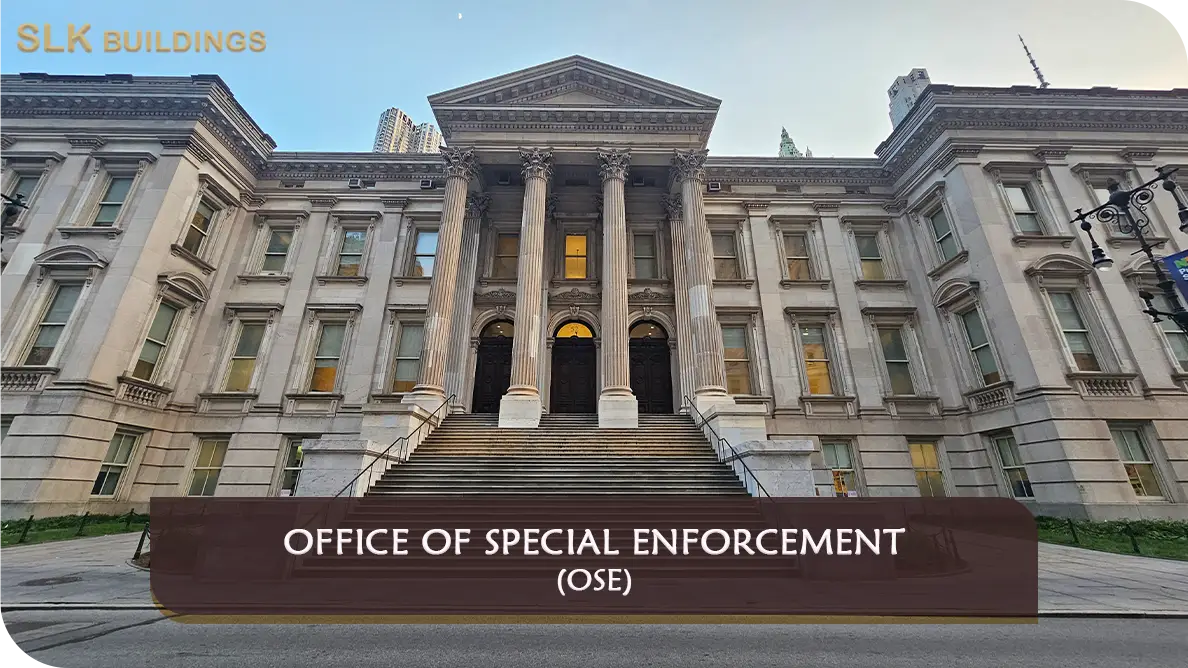
NYC OSE regulates and enforces important parts of New York City’s short-term rental system. Its work affects hosts, property owners, property managers, co-op and condominium boards, and project teams when registration, legal occupancy, building restrictions, open violations, or enforcement activity determine whether a short-term rental can be lawfully operated.
The NYC Office of Special Enforcement is the central City agency for Short-Term Rental Registration under Local Law 18 and for coordinated enforcement of illegal short-term rental activity. OSE receives registration applications, maintains the Prohibited Buildings List, publishes and reviews Class B multiple dwelling information, communicates with booking services through the verification system, and conducts enforcement activity when listings or property conditions indicate possible noncompliance.
OSE does not replace the agencies that control the underlying building conditions. DOB determines legal occupancy and administers construction-code requirements; FDNY addresses fire-safety conditions; HPD enforces housing-maintenance requirements; and OATH adjudicates many summonses. A registration or enforcement matter can therefore have several parallel tracks, each with its own documents, deadlines, and correction requirements.
This parent service hub organizes OSE work by the actual issue rather than treating all short-term rental questions as the same. A new host application, an owner’s Prohibited Buildings List request, a Class B occupancy review, a registration renewal, an enforcement notice, and a revocation matter require different records and different next actions.
OSE compliance services may be appropriate before a short-term rental begins, while an application is pending, after OSE requests additional information, or after enforcement has already started. The most efficient time to identify a property problem is usually before a registration or listing is submitted, but many issues can still be organized after a notice or denial is received.
The OSE service group is organized into focused pages so owners and hosts can move directly to the process that matches their situation:

The legal and administrative requirements change depending on the property and the service. The following issues repeatedly affect OSE registrations and enforcement reviews:
SLK Buildings helps organize OSE matters around the building record, the unit, and the underlying compliance condition. We can research DOB occupancy records, review Certificates of Occupancy and Letters of No Objection, identify open violations and orders, coordinate correction work, assemble property documentation, prepare for inspections, and determine which related agency process must be completed before or alongside the OSE submission.
For applications and renewals, the goal is to identify preventable barriers before they become a denial or delay. For enforcement matters, the goal is to separate the immediate response deadline from the longer-term building correction. For owners and boards, the goal may instead be to document building-wide restrictions, evaluate the Prohibited Buildings List process, or address unauthorized host activity without confusing private lease enforcement with City compliance.
When a matter includes an OATH summons, legal dispute, lease-enforcement question, or other issue requiring legal representation, SLK can coordinate the building-side records and correction work while the appropriate attorney or hearing representative addresses the legal proceeding.
The appropriate workflow depends on the objective. SLK begins by identifying the exact OSE service track and then builds the property record needed to support it.
This process prevents a common mistake: trying to solve an OSE problem entirely within the OSE portal when the controlling issue actually sits in DOB, FDNY, HPD, an occupancy document, or a building agreement.

OSE short-term rental compliance frequently intersects with DOB, FDNY, HPD, OATH, and private building restrictions. DOB records are especially important because OSE registration does not change a building’s legal occupancy. A unit or accessory area that is not legally approved for residential or sleeping use remains a problem even if the host otherwise meets Local Law 18 requirements.
FDNY conditions can affect safety and eligibility, HPD records may identify housing-maintenance issues, and OATH may control the adjudication of a summons. These agency tracks should be coordinated rather than merged. Each agency may require different proof of correction, inspection, certification, or hearing response.
Whether the issue involves a new registration, renewal, application problem, building restriction, open agency condition, OSE enforcement, or a question about legal occupancy, SLK Buildings can help organize the property-side review and coordinate the agencies involved.
Contact SLK Buildings for assistance with NYC OSE compliance, short-term rental registration and renewal, enforcement response, building-owner compliance, and related DOB, FDNY, HPD, and OATH matters.
SLK Buildings is a private consulting and construction-management firm and is not affiliated with the NYC Mayor’s Office of Special Enforcement or any government agency. This content provides general educational information and is not legal advice. Registration, occupancy, enforcement, correction, hearing, and violation requirements depend on the specific property, circumstances, and agency determination.
NYC Mayor’s Office of Special Enforcement (OSE) requirements can affect short-term rental hosts, property owners, tenants, building managers, and project teams throughout New York City. Local Law 18 established the City’s short-term rental registration system and requires booking services to verify that qualifying short-term rental transactions are associated with a valid registration or a lawful exemption.
Property owners and prospective hosts should review the legal occupancy of the building and dwelling unit, registration eligibility, lease or occupancy restrictions, the Prohibited Buildings List, and any open agency conditions before relying on a property for short-term rental use. Certain unresolved building or fire violations, Vacate Orders, and Stop Work Orders can prevent OSE from granting a registration until the underlying condition is resolved.
At SLK Buildings, we assist property owners, hosts, business operators, developers, contractors, architects, and project teams with NYC OSE short-term rental registration and renewal coordination, property record review, eligibility and compliance research, Prohibited Buildings List and Class B occupancy questions, violation response coordination, and related DOB, FDNY, HPD, or OATH matters when they affect an OSE issue.
Whether you are preparing a new registration, renewing an existing registration, reviewing a building’s eligibility, responding to an OSE enforcement issue, evaluating a Prohibited Buildings List matter, or addressing a building condition that affects registration, SLK Buildings can help organize the records, filings, agency coordination, and next steps needed to move the matter forward.
SLK Buildings provides free educational content to help property owners, hosts, business operators, developers, contractors, and project teams understand NYC OSE registration, enforcement, building eligibility, and short-term rental compliance requirements.
For those who prefer professional assistance, SLK Buildings is available to coordinate OSE registration and renewal documentation, property and occupancy research, agency follow-up, Prohibited Buildings List and Class B review, violation response, and related NYC agency requirements that may affect short-term rental eligibility or compliance.
SLK Buildings is a private consulting and construction-management firm and is not affiliated with the NYC Mayor’s Office of Special Enforcement or any government agency. This content provides general educational information and is not legal advice. Registration, occupancy, enforcement, correction, hearing, and violation requirements depend on the specific property, circumstances, and agency determination.
What does NYC OSE regulate?
OSE administers the Short-Term Rental Registration system and coordinates enforcement of illegal short-term rental activity. Related occupancy, building, fire, housing, and hearing requirements may be controlled by DOB, FDNY, HPD, OATH, or other authorities.
Does Local Law 18 make every short-term rental legal once it is registered?
No. Local Law 18 established registration and booking-service verification requirements. Existing rules governing legal occupancy, hosted stays, guest limits, sleeping areas, leases, and building restrictions still apply.
Does a registration legalize an illegal basement, cellar, or converted room?
No. OSE requires the space shown in a listing to be legally approved for residential and sleeping use. Registration does not replace DOB approval or legalize an unapproved conversion.
Can an owner stop registrations in a building?
A qualifying owner, board, manager, or authorized agent may be able to apply for inclusion on the Prohibited Buildings List when the required building-wide lease or occupancy restrictions prohibit short-term rentals.
Are Class B buildings exempt from Local Law 18 registration?
Legal Class B multiple dwellings approved for transient occupancy are treated differently and are exempt from the Local Law 18 registration requirement. The legal occupancy must be verified; a DOF tax classification beginning with B is not the same thing.
Can open violations affect an application?
Yes. OSE reviews agency records and identifies certain unresolved building, housing, fire, Vacate Order, Stop Work Order, and safety conditions as barriers or concerns. The specific condition and agency record should be reviewed before deciding how to proceed.
NYC Local Law 18 Compliance ~ rules for lawful hosted stays and the Short-Term Rental Registration framework.
NYC Short Term Rental Registration ~ registration documents, host information, and application coordination.
NYC Short Term Rental Eligibility ~ property and host conditions that determine whether registration may be available.
NYC OSE Prohibited Buildings List ~ owner and building restrictions affecting registration eligibility.
NYC Class B Multiple Dwellings ~ review of transient occupancy status and DOB legal occupancy records.
NYC OSE Violations ~ enforcement notices, inspections, summonses, corrections, and cross-agency coordination.
NYC Building Owner Short Term Rental Compliance ~ owner responsibilities and unauthorized tenant-hosting issues.
NYC Office of Special Enforcement ~ Registration Law
NYC Office of Special Enforcement ~ Tips for Hosting a Legal Short-Term Rental
NYC Office of Special Enforcement ~ Before You Apply
NYC Office of Special Enforcement ~ Prohibited Buildings List
NYC Office of Special Enforcement ~ Class B Multiple Dwellings List